Visiting?
Some FAQs for newcomers
What can I expect on sunday at the Good Shepherd?
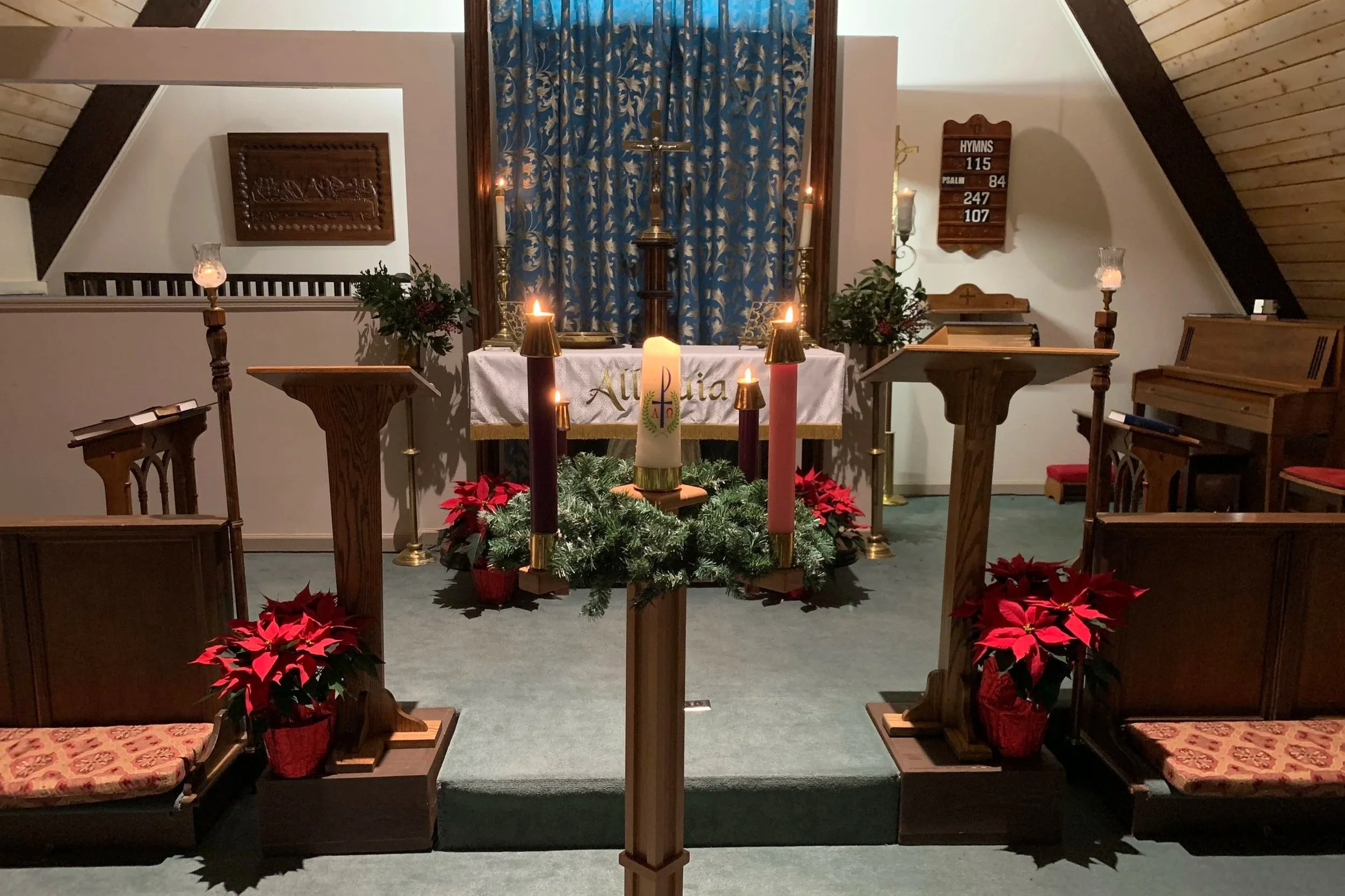
We seek to worship God in “the beauty of holiness” (Psalm 96:9), and our service is reverent and traditional. We follow the order for the Holy Eucharist from the Book of Common Prayer (2019), and our singing is accompanied by the piano (we use The Hymnal 1982). You can follow along using the prayer book you’ll find in the pew (we also provide a bulletin to help orient you).
If you’re new to traditional Christian worship, our service may feel a little strange to you at first. Don’t be afraid to ask us about what we’re doing and why! We’re happy to explain things for you.
What about children?
Children of all ages are full participants in the life of the church and in our worship, and we welcome children in all our services. We do have a nursery that you’re welcome to use, though we are not able to staff it during worship.
We will be starting regular children’s catechesis again soon. Stay tuned!
We are committed to making sure that the Good Shepherd is a safe place for children. You can learn about our diocese’s protection policy here.
Can I receive Communion at the Good Shepherd?
If you have been baptized in the name of the Father, the Son, and the Holy Spirit, and if, as the prayer book says, you “truly and earnestly repent of your sins, and seek to be reconciled with your neighbors, and intend to lead the new life, following the commandments of God, and walking in his holy ways,” you are welcome to receive Communion, even if you’re from a different Christian tradition. Baptized children are also welcome to receive.
If you are unable to commune for any reason, you are still invited to come forward and receive a blessing. Just kneel at the rail with the other communicants, cross your arms on your chest, and the priest will pray for you.
Does the Good Shepherd do private confession?
Yes—you can make an appointment with our priest for private confession. Reach out to Fr. Ethan (emccarthy@goodshepherdoa.org) to schedule a time.
How do I become a member at The Good Shepherd?
We ask potential new members to take our catechism class, which covers the basics of the Anglican tradition, and to be confirmed if they haven’t been already. New members are officially welcomed when our bishop visits.

What is Anglicanism?
Anglicanism is the Christian tradition descended from the Church of England. Anglicans around the world share a common liturgical and theological inheritance: the Book of Common Prayer, the Books of Homilies, the Ordinal, and the Thirty-Nine Articles of Religion.
Anglicanism is both Protestant and catholic. It is Protestant because it was shaped by the Protestant Reformation of the sixteenth century; it is catholic because it is in continuity with the catholic tradition received from Christ and His apostles. (The word catholic in this sense doesn’t mean Roman Catholic—it means the universal faith of all Christians everywhere.)
For more about what we believe, see our Beliefs page.
What is the Book of Common Prayer?
The Book of Common Prayer is the standard liturgy for Anglicans. The first edition was compiled by Archbishop Thomas Cranmer during the English Reformation and was published in 1549. The prayer book contains services for Morning and Evening Prayer, for the administration of Holy Eucharist and Baptism, for Marriage, Burial, and more, as well as the Psalter, schedules for Scripture reading (called lectionaries), and other prayers for use in the church’s life.
At the Good Shepherd we use the 2019 edition of the Book of Common Prayer, which is the prayer book of our own Anglican province, the Anglican Church in North America. You can find the entire Book of Common Prayer (2019) online here, and buy your own copy here.
We like to call ourselves a “prayer book parish”: the prayer book is the way we live the Christian life, not only through its daily pattern of prayer and worship, but also in its doctrine and order.
What is the Daily Office?
The Daily Office is the church’s daily service of prayer. In our Anglican tradition it is centered around Morning and Evening Prayer—short services that take about a half hour each. As our prayer book says, in these services we come into God’s presence “to give thanks for the great benefits we have received at his hands, to declare his most worthy praise, to hear his holy Word, and to ask, for ourselves and on behalf of others, those things which are necessary for our life and our salvation.” These daily prayers keep us rooted in God’s Word and in the worship of the church, and they form us more and more as people of the Gospel.
We say Morning and Evening Prayer at the church Tuesday through Friday at 8:30am and 5:00pm. You’re welcome to join us! You can also certainly pray the offices by yourself, or with your family. If you’d like to learn how to pray the offices, ask our clergy or one of the lay leaders at the church. We would love to show you!